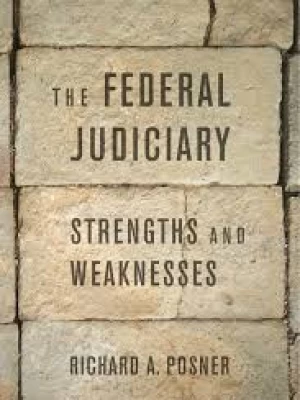
No sitting federal judge has ever written so trenchant a critique of the federal judiciary as Richard A. Posner does in this, his most confrontational book. Skewering the politicization of the Supreme Court, the mismanagement of judicial staff, the overly complex system of appeals, the threat of originalism, outdated procedures, and the backward-looking traditions of law schools and the American judicial system, Posner has written a cri de coeur and a battle cry. With the prospect that the Supreme Court will soon be remade in substantial, potentially revanchist, ways, The Federal Judiciary exposes the American legal system's most troubling failures in order to instigate much-needed reforms.
Posner presents excerpts from legal texts and arguments to expose their flaws, incorporating his own explanation and judgment to educate readers in the mechanics of judicial thinking. This rigorous intellectual work separates sound logic from artful rhetoric designed to subvert precedent and open the door to oblique interpretations of American constitutional law. In a rebuke of Justice Antonin Scalia's legacy, Posner shows how originalists have used these rhetorical strategies to advance a self-serving political agenda. Judicial culture adheres to an antiquated traditionalism, Posner argues, that inhibits progressive responses to threats from new technologies and other unforeseen challenges to society.
Richard Posner is Senior Lecturer in Law at the University of Chicago Law School.
Following his graduation from Harvard Law School, Judge Posner clerked for Justice William J. Brennan Jr. From 1963 to 1965, he was assistant to Commissioner Philip Elman of the Federal Trade Commission. For the next two years he was assistant to the solicitor general of the United States. Prior to going to Stanford Law School in 1968 as Associate Professor, Judge Posner served as general counsel of the President's Task Force on Communications Policy. He first came to the Law School in 1969, and was Lee and Brena Freeman Professor of Law prior to his appointment in 1981 as a judge of the U.S. Court of Appeals for the Seventh Circuit, where he presided until his retirement on September 2, 2017. He was the chief judge of the court from 1993 to 2000.
Judge Posner has written a number of books, including Economic Analysis of Law (7th ed., 2007), The Economics of Justice (1981), Law and Literature (3rd ed. 2009), The Problems of Jurisprudence (1990), Cardozo: A Study in Reputation (1990), The Essential Holmes (1992), Sex and Reason (1992), Overcoming Law (1995), The Federal Courts: Challenge and Reform (1996), Law and Legal Theory in England and America (1996), The Problematics of Moral and Legal Theory (1999), Antitrust Law (2d ed. 2001), Law, Pragmatism, and Democracy (2003), Catastrophe: Risk and Response (2004), Preventing Surprise Attacks: Intelligence Reform in the Wake of 9/11 (2005), How Judges Think (2008), and A Failure of Capitalism: The Crisis of '08 and the Descent into Depression (2009), as well as books on the Clinton impeachment and Bush v. Gore, and many articles in legal and economic journals and book reviews in the popular press. He has taught administrative law, antitrust, economic analysis of law, history of legal thought, conflict of laws, regulated industries, law and literature, the legislative process, family law, primitive law, torts, civil procedure, evidence, health law and economics, law and science, and jurisprudence. He was the founding editor of the Journal of Legal Studies and (with Orley Ashenfelter) the American Law and Economics Review. He is an Honorary Bencher of the Inner Temple and a corresponding fellow of the British Academy, and he was the President of the American Law and Economics Association from 1995 to 1996 and the honorary President of the Bentham Club of University College, London, for 1998. He has received a number of awards, including the Thomas Jefferson Memorial Foundation Award in Law from the University of Virginia in 1994, the Marshall-Wythe Medallion from the College of William and Mary in 1998, the 2003 Research Award from the Fellows of the American Bar Foundation, also in 2003 the John Sherman Award from the U.S. Department of Justice, the Learned Hand Medal for Exellence in Federal Jurisprudence from the Federal bar Council in 2005, and, also in 2005, the Thomas C. Schelling Award from the John F. Kennedy School of Government at Harvard University.
 Login
Login

 My
Wishlist
My
Wishlist